
AI That Never Leaves Your Building
miigEngine is a privacy-first AI inference engine that runs entirely on your own computer, with your own GPU. No cloud. No subscriptions to foreign servers. Standard chat and legal-RAG workflows run locally in your environment. Your documents, questions, and knowledge base remain under your control.
🚀 Our Mission 🚀
Give communities and organizations real AI capability without giving up control of their data
Most AI tools ask you to send your files, questions, and institutional knowledge to infrastructure you do not own and cannot inspect. That creates a sovereignty problem first and a privacy problem second: your work leaves your machine, enters someone else’s system, and becomes subject to their infrastructure, their policies, and sometimes even foreign legal reach. We built miigEngine so communities and organizations can use real AI capability on hardware they already control, without turning privacy into a recurring subscription.
- Sovereignty matters (your data should stay on infrastructure you physically control, not on a provider's remote server)
- Environmental concerns are valid (cloud AI runs through energy-intensive data centres, while miigEngine runs on a single local machine)
- Communities need possession (real control means your knowledge stays with you, not with a vendor)
We exist because AI capability should not require renting out your privacy, your autonomy, or your data governance.
A Computer, Not a Data Centre
miigEngine runs open-weight AI models locally on a single machine with a GPU, instead of relying on any external cloud infrastructure. There is no server farm, no cooling towers, no water usage at industrial scale. Its footprint is that of a gaming PC, because that’s exactly the class of hardware it uses.
What We Believe
- Sovereignty needs possession. If your AI runs on someone else's server, it is their infrastructure handling your data, not yours.
- Trust requires verification — open-weight models, transparent system controls, and air-gapped operation when needed, not just a privacy policy.
- Privacy is a right, not a feature: technology should reduce surveillance, not create new avenues for it.
- OCAP principles (Ownership, Control, Access, Possession) guide how we build for Indigenous communities and for any organization seeking genuine data sovereignty.
No Vendor Lock-in, By Design
miigEngine runs on your hardware, under your roof. No license servers. No telemetry. No remote management plane. Once it is installed, it keeps working whether or not Miigwech AI Solutions is even still in business.
What happens if Miigwech shuts down? Nothing changes for you. There is no ongoing relationship with our infrastructure to break, no calls home, no subscription validation, no forced obsolescence. This is a one-time deployment, not an operational dependency.
The Problem
Too much paperwork, too few hands, and no AI tool you can actually trust
The Real Trade-off Everyone's Being Sold
Mainstream AI tools can absolutely help with grant applications, reports, correspondence, and the growing administrative backlog. The problem is where that work happens. In most products, every prompt, every document, and every question is routed to a remote provider's infrastructure. That means your information is no longer governed only by your own policies or your own physical control.
For many organizations, that is not a theoretical concern. Cross-border legal exposure, foreign provider control, and dependence on infrastructure you cannot inspect all create real sovereignty risk. Laws like the U.S. CLOUD Act are part of that picture, but the bigger issue is architectural: if the work happens on someone else's system, then your privacy depends on promises, contracts, and jurisdictions you do not control.
On top of that, cloud AI carries a real environmental cost. Every one of those queries runs through a data centre, a facility drawing megawatts of power and large-scale cooling resources. For organizations raising environmental concerns about AI, that is not a side note. It is a legitimate design issue.
⚠️ Why "Just Don't Use AI" Isn't a Real Answer ⚠️
The backlog does not disappear. Grant reports, band council documentation, correspondence, and admin work keep piling up whether or not you trust the available tools.
Governments are already reacting. Across Europe and elsewhere, public institutions are beginning to restrict or phase out foreign cloud tools for sensitive work because sovereignty and cross-border access risks are no longer abstract concerns.
Even Canada's own policy discussions have made the issue clear: data sovereignty is incomplete when the provider controlling the infrastructure remains subject to foreign law. That is exactly the condition miigEngine is designed to avoid.
⚙️ miigEngine ⚙️
AI inference that stays on your machine, in your building, under your control
The Sovereign Solution: miigEngine
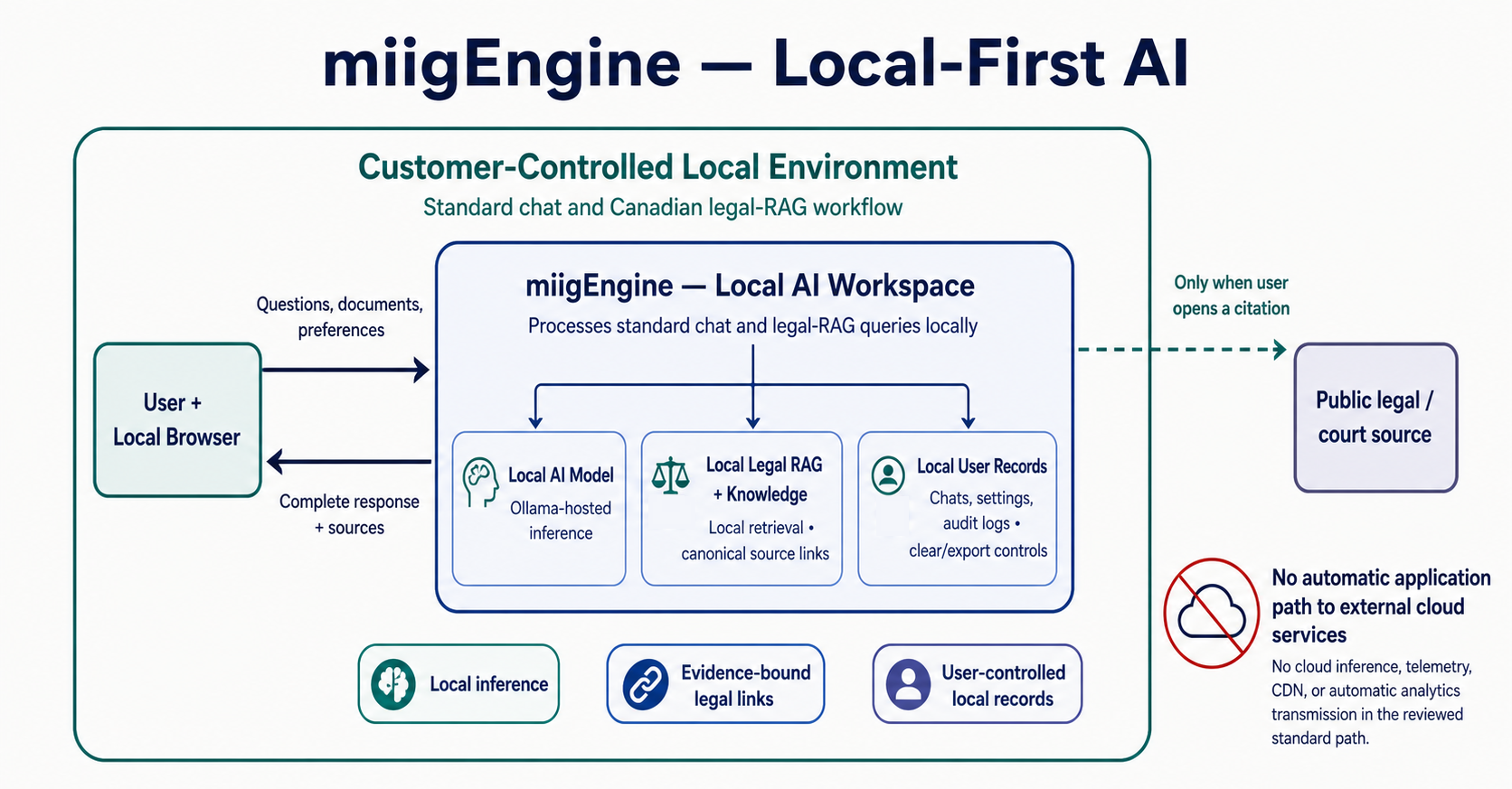
miigEngine is software that runs open-weight AI language models directly on a computer you already own or control, using its GPU. There is no cloud-inference dependency, no automatic application connection to external services in the standard local workflow, and no account that phones home. It can be operated without internet access; when internet is enabled, public legal or court sites are reached only if a user chooses to open a displayed citation.
It answers questions, drafts documents, and searches your own files and knowledge base with an optional legal-research mode (A2AJ RAG) that retrieves Canadian case law and statutes from a local database, with citation-link grounding that maps model-generated legal links to canonical URLs held in the retrieved source records.
*For clarity, some GIFs are shortened to omit processing time and show the results.
A2AJ Legal RAG
Specialized retrieval-augmented search over Canadian legal sources, with correctly linked citations.
Generate Documents
Generate documents at scale: miigEngine reads and fills complex forms against templates we configure for your organization, so the AI can crank through large batches of reports, letters, and forms grounded in A2AJ legal research instead of legalese.
Live Transparency Panel
Every action is logged and visible in real time — response sources, query anchors, and analytics, so trust doesn't rely on a promise.
Translate Legal Documents
Upload a legal document and miigEngine turns it into plain English, no law degree needed. Ask it about specific clauses, risks, or anything else in the document.
Model Immutability Dashboard
Verify the running model matches the original vendor baseline, and restore it on demand — the model can't quietly drift or be tampered with.
Accessibility & Local Control
WCAG-friendly display settings, adjustable fonts and themes, interaction and chat data controls — all handled locally.
Who Needs This
First Nations & Indigenous Organizations
Communities who want AI's benefits without giving up OCAP-aligned ownership, control, access, and possession of their own information.
Small Offices with Big Backlogs
Understaffed admin teams buried in grant reports, correspondence, and forms who need real help, not another subscription.
Legal & Compliance Teams
Anyone who needs correctly cited legal research without exposing case files to a foreign cloud provider.
Anyone Who Asked "Is It Actually Private?"
If your team has ever hesitated to paste sensitive information into ChatGPT, this was built for that exact hesitation.
The Difference
Cloud AI tools route your work through infrastructure you will never see and do not control. miigEngine takes the opposite approach: it runs on your machine, uses open-weight models, works entirely under your control, and never phones home. Privacy here is architectural, not contractual.
Support & Onboarding
Master Recovery USB - one-step factory reset if mistakes happen
Every miigEngine deployment includes a Master Recovery USB: a factory-reset safeguard for your on-premise AI system. If your team makes a configuration mistake, deletes critical files, or needs to return the system to a known-good state, the Recovery USB restores miigEngine to its original working configuration—without a remote support call or a full reinstall from scratch.
Visual Guides & Quick-Start Documentation
Your deployment also includes locally stored visual guides, annotated screenshots, and plain-language documentation covering initial setup, daily use, common tasks, and basic troubleshooting. Staff can follow clear, step-by-step instructions without relying on external websites, video platforms, or a support call—helping your team become confident and self-sufficient sooner.
📄 Policies 📄
Transparency and trust in everything we do
Privacy Policy
miigEngine Privacy Policy
1. Core Privacy and Sovereignty Principles
We design miigEngine according to privacy-by-architecture and data sovereignty principles so that your data stays under your physical and legal control. Miigwech does not access, process, or store the prompts, outputs, documents, or user data that pass through your miigEngine deployment. miigEngine is engineered to avoid exposure to the U.S. CLOUD Act by operating without U.S. infrastructure, U.S. cloud services, or U.S. telemetry dependencies. It operates entirely offline by design; it does not connect to the internet, external APIs, or remote services of any kind. We treat laws like PIPEDA and GDPR-style regimes as a minimum floor, not a ceiling; our design choices aim to materially reduce external access risks rather than relying solely on policy promises.
2. Scope of this Policy
This Policy covers:
- The miigEngine software and its base system components.
- Bundled local applications and interfaces delivered as part of miigEngine, when run on your own infrastructure under your control.
- Our handling of limited transactional data required to sell and deliver the Product and meet legal obligations.
This Policy does not cover how you or your users configure, operate, or use miigEngine within your organization. You are the data controller for all prompts, outputs, documents, and user information processed on your own systems.
3. No Remote Access, No Telemetry, No Internet
No backdoors, no remote administration:
- Miigwech cannot remotely connect to your miigEngine deployment.
- We do not maintain admin credentials, remote tunnels, or hidden accounts.
No telemetry or monitoring:
- miigEngine does not send Miigwech usage logs, user identifiers, prompts, model outputs, documents, or system metrics.
- We do not collect crash reports, performance statistics, or configuration data from your deployment.
No automatic internet connectivity for standard local workflows:
- miigEngine’s standard chat and local legal-RAG workflows do not initiate non-localhost internet connections for cloud inference, telemetry, external analytics, or remote administration.
- Where a user intentionally opens a displayed citation, their browser may navigate to a public court or legal website. This user-initiated browser action is distinct from miigEngine transmitting prompts, outputs, documents, or operational data to an external service.
No centralized user database:
- We do not operate any central service that knows which users exist inside your miigEngine environment.
- All identities and session management are local to your infrastructure and under your control.
Any prompts, outputs, or documents processed by miigEngine inside your network are your responsibility and remain entirely outside Miigwech's operational reach.
4. OCAP and Indigenous Data Sovereignty
Miigwech expressly aligns the design and intended use of miigEngine with the First Nations Principles of OCAP® (Ownership, Control, Access, and Possession) and broader Indigenous data sovereignty frameworks.
Ownership: Communities and organizations own their data in full. miigEngine is built so that your prompts, documents, and AI outputs do not become a resource for external parties, including Miigwech.
Control: You control what information is submitted to the AI, how outputs are used, and how the system is configured. All AI activity occurs entirely within your governance processes.
Access: Decisions about who may use miigEngine, under what conditions, and for what purposes are made by you, not Miigwech.
Possession: Physical custody of the hardware running miigEngine is a core protection mechanism. miigEngine is installed within your environment so that you maintain physical possession of the systems hosting your AI inference and any associated data.
Where there is any tension between OCAP-aligned sovereignty principles and convenience for Miigwech, the Product is intentionally designed to favour sovereignty, not convenience. OCAP® is a registered trademark of the First Nations Information Governance Centre (FNIGC). This Policy acknowledges OCAP® as a foundational framework for Indigenous data governance and sovereignty.
5. Relationship to PIPEDA and Other Laws
PIPEDA as a baseline: Miigwech complies with Canada's Personal Information Protection and Electronic Documents Act (PIPEDA) in how we handle the limited personal information we collect for sales, invoicing, and legal compliance.
Beyond minimum compliance: Because miigEngine does not send operational data back to Miigwech, and because all AI inference occurs locally on your hardware, many traditional privacy risks associated with cloud-based AI services do not arise. Our aim is to meet or surpass both PIPEDA and GDPR-style expectations by design, not merely by policy.
International use: For customers outside Canada, this same architecture — no automatic application-initiated internet dependency for standard local workflows — is intended to support compliance with local privacy and data sovereignty laws by keeping all AI activity within your control and your jurisdiction.
6. Information We Collect from Customers
Miigwech only collects information necessary to: (a) sell and deliver miigEngine licenses, and (b) comply with applicable tax and business laws.
6.1 Transactional and Business Information
When you purchase miigEngine, we may collect:
- Organization or individual name.
- Billing and invoicing address.
- Contact information (such as email and/or phone for billing and logistics).
- Details of the product purchased (license type, price, invoice details).
- Tax-relevant information required by law in the applicable jurisdiction.
We do not collect information about the prompts you submit, the outputs the model generates, the documents you process, or the identities and activities of your internal users.
6.2 Payment Processing and Third-Party Service Providers
If third-party payment processors or invoicing tools are used, your payment or billing details may be processed by those providers under their own terms and privacy notices. We do not store full payment card details on our own systems where this can be avoided.
Where we engage third-party service providers to assist with billing, accounting, or record-keeping, we require them by contract to:
- Use customer information only for the specific services we request.
- Apply appropriate safeguards designed to protect confidentiality and security.
- Comply with applicable privacy and data protection laws.
We do not sell or rent customer information to third parties.
7. How We Use Customer Information
We use the limited customer information described above to:
- Process and record sales, invoicing, and delivery of software licenses.
- Meet accounting, audit, and tax obligations under applicable law.
- Maintain basic records of business relationships (e.g., invoices issued).
We do not use this information for behavioural profiling, advertising, or analytics.
8. Data Retention for Customer Records
We retain transactional and invoicing records only as long as required by applicable tax, accounting, and corporate law, after which they are securely deleted or anonymized.
We do not retain, and have no ability to retain, any operational data from your miigEngine deployment, because such data never transits our infrastructure.
9. How miigEngine Handles User Data Locally
miigEngine processes prompts and returns outputs entirely within your local environment. By default:
- Prompts and model outputs are processed locally. Depending on the features enabled and how the deployment is configured, conversation history may be stored locally in the miigEngine chat-history database, session state may be stored locally, and audit activity may be written to local audit logs. These records remain on infrastructure controlled by the customer and are not automatically transmitted to Miigwech.
You are responsible for configuring data handling, retention, and deletion within your miigEngine deployment in accordance with your own legal, regulatory, and community requirements.
10. Your Role as Data Controller
For all prompts, outputs, documents, and operational data processed on miigEngine, you (or your organization or community) act as the data controller:
- You determine what information is submitted to the AI and how outputs are used.
- You configure authentication, access controls, and session management.
- You decide how to meet your own obligations under PIPEDA, OCAP, and any other applicable frameworks with respect to individuals whose information you manage.
Miigwech acts only as a software vendor, not as a data processor or service provider for your operational AI data.
11. Security Design and Customer Responsibilities
Our responsibilities:
- Design and ship miigEngine without backdoors, remote access channels, cloud-inference dependencies, automatic telemetry, or automatic transmission of deployment data to Miigwech.
- Avoid reliance on U.S. cloud, telemetry, or internet infrastructure in the default design.
- Provide security-focused product documentation where needed.
Your responsibilities:
- Secure physical and network access to the host running miigEngine.
- Configure application-level security according to your risk model and legal obligations.
- Maintain backups, incident response plans, and any required policies for your users.
Because we do not control or operate your environment, we cannot be responsible for your internal configuration, network security, or user practices.
12. No Technical Support Obligation
Miigwech does not provide general technical support, managed services, or ongoing administration for your miigEngine deployment. Any voluntary assistance we may choose to provide (for example, documentation or one-time guidance) does not create an ongoing duty to support or monitor your systems. We do not operate support channels that involve connecting into your environment or collecting diagnostic data from your deployment.
13. Disclaimers and Limitation of Liability
"AS IS" provision: miigEngine is provided "AS IS" and "AS AVAILABLE" without warranties of any kind, whether express, implied, or statutory, including any implied warranties of merchantability, fitness for a particular purpose, or non-infringement.
Limitation of liability: To the maximum extent permitted by law, Miigwech's total liability for any claim related to miigEngine will not exceed the amount you paid for the specific license giving rise to the claim in the twelve (12) months preceding the event. We are not liable for indirect, incidental, special, consequential, or punitive damages.
AI output disclaimer: miigEngine generates outputs using open-weight AI models. Outputs may be incomplete, inaccurate, or unsuitable for specific purposes. You are solely responsible for reviewing, validating, and acting on any output produced by miigEngine. Miigwech makes no representation that outputs are legally accurate, professionally compliant, or fit for any particular use.
Force majeure: We are not responsible for delays or failures caused by events beyond our reasonable control, such as natural disasters, war, government actions, or network failures.
14. User Rights and Complaints (PIPEDA Context)
For the limited personal information we hold about you as a customer (e.g., invoicing data), you may have rights under PIPEDA and similar laws, including the right to:
- Request access to the personal information we hold about you in our business records.
- Request corrections to inaccurate information.
- Challenge our compliance with applicable privacy principles.
Privacy-related complaints should be directed to our designated Privacy Officer. Unresolved complaints may be escalated to the Office of the Privacy Commissioner of Canada or the relevant authority in your jurisdiction. Nothing in this Policy limits your right to make a complaint to the Office of the Privacy Commissioner of Canada or to any other applicable supervisory authority.
15. Governing Law and Dispute Resolution
This Privacy Policy is governed by the laws of the Province of Ontario and the federal laws of Canada applicable therein. Any disputes arising from or relating to this Policy or your purchase of miigEngine shall be resolved through binding arbitration in Ottawa, Ontario, in accordance with applicable Canadian arbitration rules, except where prohibited by law. Nothing in this section limits your right to raise concerns or complaints with the Office of the Privacy Commissioner of Canada or any other relevant privacy regulator.
16. Policy Changes
We may update this Privacy Policy from time to time to reflect changes in law or our business practices relating to customer records. Material changes affecting how we handle customer information will be communicated using the contact details associated with your purchase, where feasible, before they take effect. Because miigEngine does not transmit operational data to us, changes to this Policy do not change your local AI governance; they only affect how we handle the minimal customer information we hold.
17. Contact Information
Privacy Officer
Miigwech AI Solutions
Ottawa, Ontario
Norman@northmail.ca
Use this contact for:
- Questions about this Privacy Policy.
- Requests related to access or correction of your customer information.
- Privacy or data protection complaints.
No technical support is offered through this contact channel.
Data Deletion Policy
Data Deletion Policy
1. Overview
At Miigwech AI Solutions, we respect your right to control your information. miigEngine is designed for sovereign, on-premises deployment on your infrastructure, giving you complete control over all AI inference activity, session data, and any associated logs. This policy explains:
- What data miigEngine typically stores locally.
- Where deletion and retention are controlled by you vs. Miigwech.
- Recommended patterns for secure deletion and retention.
miigEngine does not transmit operational data to Miigwech. In virtually all cases, you are the sole party with the ability to access, retain, or delete data generated by your miigEngine deployment.
2. Data Categories in miigEngine
In a standard deployment, miigEngine may handle:
- Identity and access data — User accounts, roles, password hashes, session tokens, API keys.
- Inference session data — Prompts submitted by users, model outputs, conversation history (where session persistence is enabled).
- Uploaded documents — Files submitted to the AI for processing or retrieval-augmented inference.
- Operational logs — HTTP/audit logs for the admin UI and APIs, system events, login events.
- Ephemeral data — Short-lived session cookies, cache, and transient inference state.
Exact data categories depend on how you configure and use your miigEngine instance.
3. Who Controls Deletion
Because miigEngine is deployed on your infrastructure:
- You control the storage systems (disks, databases, session stores, backups) where miigEngine data resides.
- You control when data is deleted, anonymized, or retained under your own policies.
- Miigwech does not reach into your environment to delete or retain any data unless explicitly agreed in a managed-service contract.
If Miigwech also operates a hosted miigEngine instance on your behalf, that hosted environment will have a separate, written data retention/deletion schedule as part of your service agreement.
4. Deletion Mechanisms (Typical Patterns)
4.1 User Accounts and Access
Administrators can disable or remove accounts using the miigEngine admin interface or API. Typical effects:
- Disable user — prevents login; account record and historical logs remain.
- Delete user (where implemented) — removes the user record; logs may retain a non-identifying reference (e.g., a numeric ID) for audit integrity.
We recommend:
- Deactivate users for most HR/lifecycle events.
- Use anonymization or log rotation (see 4.3) if you need to remove identifying information from historical logs.
4.2 Inference Session Data and Uploaded Documents
Deletion of session history and uploaded documents is fully under your control:
- Use your database tools, admin interface, or application logic to delete session records, conversation histories, and uploaded files.
- miigEngine does not silently mirror or back up your inference data to Miigwech-controlled infrastructure.
- If you implement operational scripts or CLI tools for bulk deletion, document them in your internal runbooks rather than relying on them as hardwired guarantees from Miigwech.
4.3 Audit Logs and System Logs
By default, miigEngine can record audit logs (e.g., timestamp, method, path, status, remote IP, user ID) for security and compliance purposes. Recommended pattern:
- Short-term detailed logs (e.g., 30–90 days) for active investigations and incident response.
- Optional longer-term, reduced logs (e.g., summarized or anonymized) if you need historical metrics without personal identifiers.
Implement log rotation and deletion via:
- Database retention jobs (e.g., scheduled DELETE FROM audit_logs WHERE timestamp < ...).
- Filesystem rotation for any text-based logs (e.g., logrotate).
miigEngine does not force a retention schedule; you define this based on your legal and policy obligations.
5. Ephemeral Session and Inference Data
By default, miigEngine handles inference transiently:
- In-flight prompts and outputs are processed in memory and not persisted to long-term storage unless your configuration explicitly enables session history.
- Session cookies are short-lived, http-only, and local to the user's browser session. They are not stored server-side beyond the active session.
- Conversation exports downloaded by users are delivered directly to the user's device and are not retained by miigEngine after delivery.
These behaviors are part of miigEngine's privacy-by-default design and are intended to minimize persistence of sensitive inference content.
6. Backups, Snapshots, and Emergency Deletion
Because miigEngine runs inside your environment:
- Backups and snapshots (e.g., database dumps, volume snapshots) are created, stored, and deleted according to your own policies.
- If you restore from an older backup, previously deleted session data or documents may reappear until deleted again.
For emergency deletion (e.g., credential compromise, incident response), your administrators can:
- Revoke user credentials and session tokens.
- Delete specific session histories, conversation records, or uploaded document stores.
- Purge or rotate logs.
- Destroy or overwrite storage volumes.
Miigwech can provide guidance or scripts as part of support, but actual deletion is performed by your team unless a managed-service contract states otherwise.
7. Irreversibility and Recovery
miigEngine is intentionally designed so that:
- Miigwech does not maintain shadow copies of your inference data, prompts, outputs, or documents outside of your control.
- If your team deletes data from your environment (and from any backups and snapshots you control), Miigwech cannot restore it for you.
- You are responsible for implementing and testing a backup and recovery strategy consistent with your own retention obligations and risk tolerance.
8. Alignment with Sovereignty and Privacy Frameworks
This approach to data retention and deletion is intended to support:
- OCAP® principles (Ownership, Control, Access, Possession) for First Nations data governance.
- PIPEDA and applicable Canadian privacy laws regarding limiting collection, retention, and use.
- Data sovereignty expectations where communities and public bodies require that AI inference data remain in their legal and physical control.
- The spirit of the "right to erasure" under GDPR-like frameworks, to the extent you implement deletion and anonymization workflows in your environment.
9. How to Exercise Deletion or Retention Choices
Because miigEngine is deployed in your environment:
- End-users should send access or erasure requests to your organization, not to Miigwech.
- Your administrators can then:
- Disable or delete accounts in miigEngine.
- Delete or anonymize conversation histories, session records, and uploaded documents.
- Apply log retention and deletion policies per your governance framework.
If you operate a Miigwech-hosted instance, details of how we execute deletion on your behalf (and timelines) will be documented in your service agreement and/or Data Processing Addendum.
Licensing and Purchasing Agreement
Pilot License and Purchase Agreement
Pilot License and Purchase Agreement.pdf
1. Parties
Vendor: Miigwech AI Solutions ("Miigwech," "we," "us")
Customer: The organization or individual named on the accompanying invoice ("Customer," "you")
2. Purpose and Scope
This Agreement governs a pilot deployment of the miigEngine software for evaluation and testing purposes. The pilot is intended to:
- Allow the Customer to evaluate miigEngine's suitability for their operational environment.
- Provide Miigwech with feedback to refine the product.
- Establish a working relationship prior to broader deployment.
This is a limited, non-production pilot license. Full production deployment requires a separate commercial agreement.
3. Definitions
- Software means the miigEngine web application, including all compiled binaries, configuration files, documentation, and bundled components delivered under this Agreement.
- Pilot Period means the evaluation period commencing upon delivery of the Software and ending ninety (90) days thereafter, unless extended in writing by mutual agreement.
- Invoice means the written invoice issued by Miigwech to the Customer specifying the product, price, and payment terms.
4. Pilot License Grant
Subject to the terms of this Agreement and receipt of cleared payment in full, Miigwech grants the Customer a:
- Limited-duration — valid only during the Pilot Period.
- Non-exclusive — other customers may participate in concurrent pilots.
- Non-transferable — the license is granted to the named Customer organization only.
- Internal evaluation only — not for production use, not for third-party service delivery.
This license permits the Customer to install, deploy, and operate the Software for internal evaluation and testing purposes.
5. Permitted Use
During the Pilot Period, the Customer may:
- Install and run the Software on infrastructure under their control.
- Allow a reasonable number of authorized users within their organization to access and test the Software.
- Evaluate the Software's functionality, performance, and fit for their requirements.
- Provide feedback to Miigwech regarding usability, bugs, and feature requests.
- Make backup copies for disaster recovery purposes.
6. Restrictions
The Customer may not:
- Use the Software for production workloads or mission-critical operations.
- Resell, sublicense, lease, or otherwise transfer the Software to any third party.
- Share access to the Software with parties outside the Customer organization.
- Reverse engineer, decompile, or disassemble the Software beyond what is permitted by applicable law.
- Remove or alter any proprietary notices, branding, or attribution within the Software.
- Represent the Software as their own product or rebrand it for external distribution.
Violation of any restriction in this section constitutes a material breach and may result in immediate termination of the pilot license.
7. Payment Terms
7.1 Invoicing
Miigwech will issue an invoice to the Customer prior to delivery of the Software. The invoice will specify the product, quantity, pilot fee (if any), and payment due date.
7.2 Payment Due
Payment is due within Net 30 days of the invoice date unless otherwise stated on the invoice.
7.3 Accepted Payment Methods
Miigwech accepts payment by electronic funds transfer (EFT), wire transfer, or cheque. No payment gateway or credit card processing is offered. Bank details for EFT will be provided on the invoice.
7.4 Purchase Orders
Miigwech will accept a Customer-issued Purchase Order (PO) as confirmation of intent to purchase. Delivery of the Software will occur upon cleared payment, not upon PO issuance.
7.5 Taxes
The Customer is responsible for all applicable taxes, duties, or levies imposed by their jurisdiction on the purchase of the Software. Where Miigwech is required by law to collect and remit taxes, these will be itemized on the invoice.
8. Delivery
8.1 Delivery Method
Miigwech will deliver the Software electronically to the contact email specified on the invoice. Delivery may include:
- Software binaries, container images, or installation packages.
- Installation and configuration documentation.
- Any pilot-specific setup instructions.
8.2 Delivery Timeline
Delivery will occur within five (5) business days of confirmed payment clearance.
8.3 Customer Responsibility
The Customer is responsible for deployment, configuration, and operation of the Software on their own infrastructure. Miigwech does not provide installation services unless separately agreed in writing.
9. Pilot Period and Transition
9.1 Duration
The Pilot Period is ninety (90) days from the date of delivery, unless extended in writing by mutual agreement.
9.2 End of Pilot
At the conclusion of the Pilot Period:
- The Customer may choose to enter into a full commercial license agreement with Miigwech.
- If no commercial agreement is reached, the Customer must cease use of the Software and destroy all copies in their possession.
- Miigwech has no obligation to provide continued access, updates, or support beyond the Pilot Period.
9.3 Feedback and Collaboration
The Customer agrees to provide reasonable feedback on the Software's performance, usability, and suitability during the Pilot Period. Miigwech may use such feedback to improve the product without obligation to the Customer.
10. No Technical Support Obligation
Miigwech does not provide formal technical support, managed services, installation assistance, or ongoing administration under this Pilot Agreement. Miigwech may, at its sole discretion, provide informal guidance, documentation, or assistance during the pilot to facilitate evaluation. Such assistance does not create an ongoing support obligation.
11. Sovereignty and OCAP Alignment
Miigwech designs miigEngine in accordance with the First Nations Principles of OCAP® (Ownership, Control, Access, and Possession). Upon delivery:
- The Customer holds full possession and control of the Software and all data processed by it during the Pilot Period.
- Miigwech retains no access to, copy of, or visibility into the Customer's deployment or data.
- The Software operates entirely offline with no telemetry, remote access, or internet dependency.
OCAP® is a registered trademark of the First Nations Information Governance Centre (FNIGC).
12. Warranties and Disclaimers
12.1 Limited Delivery Warranty
Miigwech warrants that the Software will be delivered free of known malware and will function substantially as described in accompanying documentation at the time of delivery.
12.2 Pilot Software "As Is" Disclaimer
THE SOFTWARE IS PROVIDED FOR EVALUATION PURPOSES ON AN "AS IS" BASIS. MIIGWECH MAKES NO WARRANTIES, EXPRESS OR IMPLIED, REGARDING THE SOFTWARE'S PERFORMANCE, RELIABILITY, SUITABILITY FOR PRODUCTION USE, OR FITNESS FOR ANY PARTICULAR PURPOSE.
Because this is a pilot, the Software may contain bugs, incomplete features, or limitations not present in a final commercial release. The Customer acknowledges and accepts these risks as part of the evaluation process.
12.3 AI Output Disclaimer
miigEngine generates outputs using AI models. Outputs may be incomplete, inaccurate, or unsuitable for specific purposes. The Customer is solely responsible for reviewing, validating, and acting on any AI-generated output. Miigwech makes no representation that outputs are legally accurate, professionally compliant, or fit for any particular use.
13. Limitation of Liability
TO THE MAXIMUM EXTENT PERMITTED BY APPLICABLE LAW:
- Miigwech's total liability for any claim arising under or related to this Agreement shall not exceed the amount paid by the Customer for the pilot license.
- Miigwech shall not be liable for indirect, incidental, special, consequential, or punitive damages, including loss of data, loss of revenue, or loss of business opportunity, even if advised of the possibility of such damages.
Because this is a pilot for evaluation purposes, the Customer agrees to implement appropriate safeguards (backups, non-production data, isolated environments) to minimize risk.
14. Confidentiality
Both parties agree to keep confidential any non-public technical or business information disclosed during the pilot. This obligation survives termination of the Agreement for a period of three (3) years.
Confidential information does not include information that:
- Was publicly available prior to disclosure.
- Becomes publicly available through no breach of this Agreement.
- Was independently developed without use of the disclosing party's information.
15. Data and Privacy
The Customer is the data controller for all prompts, outputs, documents, and operational data processed on miigEngine during the pilot. Miigwech does not access, collect, or retain any such data. For full details on privacy and data handling, refer to the miigEngine Privacy Policy, which is incorporated by reference.
16. Term and Termination
16.1 Term
This Agreement commences upon delivery of the Software and continues for the duration of the Pilot Period.
16.2 Termination for Breach
Either party may terminate this Agreement upon written notice if the other party materially breaches this Agreement and fails to cure the breach within fifteen (15) days of notice.
16.3 Termination for Convenience
Miigwech may terminate this pilot at any time with thirty (30) days' written notice. In such case, Miigwech will refund any unused portion of the pilot fee on a pro-rata basis.
16.4 Effect of Termination
Upon termination for any reason, the Customer must cease use of the Software and destroy all copies in their possession. Sections 10, 12, 13, 14, 17, and 18 survive termination.
17. Governing Law and Dispute Resolution
This Agreement is governed by the laws of the Province of Ontario and the federal laws of Canada applicable therein.
Any dispute arising from or relating to this Agreement shall be resolved through binding arbitration in Ottawa, Ontario, in accordance with applicable Canadian arbitration rules, except where prohibited by law.
18. General Provisions
- Entire Agreement — This Agreement, together with the accompanying Invoice and Privacy Policy, constitutes the entire agreement between the parties with respect to the pilot and supersedes all prior negotiations, representations, or agreements.
- Amendments — Any amendment to this Agreement must be in writing and signed by both parties.
- Severability — If any provision is found unenforceable, the remaining provisions remain in full force.
- No Waiver — Failure to enforce any provision does not constitute a waiver of future enforcement.
- Language — This Agreement is written in English. Any translation is for convenience only; the English version governs.
- Independent Contractors — The parties are independent contractors. Nothing in this Agreement creates a partnership, joint venture, or employment relationship.
19. Contact
Miigwech AI Solutions
Ottawa, Ontario
Norman@northmail.ca
For pilot inquiries, invoice questions, and general pilot support. Note that formal technical support is not provided under this pilot agreement.
By paying the Invoice associated with this Agreement, the Customer acknowledges that they have read, understood, and agree to be bound by the terms of this Pilot License and Purchase Agreement.
📭 Get In Touch 📬
Interested in miigEngine for your organization or community? Let's talk.
🔎 A Closer Look 🔍
A technical case study for people who want to inspect how miigEngine handles local processing and legal RAG.
Citation URL Grounding and Validation for Legal RAG Responses
Local language models can produce legal URLs that look plausible without necessarily reproducing the exact source URL returned by retrieval. miigEngine treats model-generated legal links as untrusted output: it matches the nearby citation against the cases and laws retrieved for the current response, substitutes the canonical URL stored in the local record, and validates response URLs against the permitted source set. The excerpt below is a sanitized production module. It demonstrates the citation URL-grounding control without exposing miigEngine’s database schema, ingestion process, retrieval/indexing pipeline, model configuration, or deployment package.
[Read the full case study]"""Citation URL grounding and validation for legal RAG responses."""
import re
from typing import List, Dict
def fix_urls_in_response(response_text: str, retrieved_cases: List[Dict], retrieved_laws: List[Dict] = None) -> str:
"""
Replace all generated CanLII URLs with actual database URLs.
This is needed because Mistral Nemo generates pattern-based URLs
instead of copying exact URLs from context.
Args:
response_text: The LLM's response text containing generated URLs
retrieved_cases: List of case dicts with 'citation' and 'url' keys
retrieved_laws: Optional list of law dicts with 'citation' and 'url' keys
Returns:
Response text with corrected URLs
"""
# Build lookup of citations to correct URLs
citation_to_url = {}
# Add case URLs
for case in retrieved_cases:
if case.get('citation') and case.get('url'):
citation_to_url[case['citation']] = case['url']
# Add law URLs if provided
if retrieved_laws:
for law in retrieved_laws:
if law.get('citation') and law.get('url'):
citation_to_url[law['citation']] = law['url']
# Pattern to match generated CanLII URLs
# Matches: https://www.canlii.org/... or https://decisions.scc-csc.ca/...
url_pattern = r'https?://(?:www\.canlii\.org|decisions\.scc-csc\.ca|coadecisions\.ontariocourts\.ca|decisions\.fct-cf\.gc\.ca)/[^\s$<>"\'\n]+'
def replace_url(match):
"""Replace an LLM-generated legal URL with a canonical retrieved-source URL."""
generated_url = match.group(0)
# Get context around this URL (200 chars before)
start = max(0, match.start() - 200)
end = match.end()
context = response_text[start:end]
# Check if any known citation appears near this URL
for citation, correct_url in citation_to_url.items():
# Look for citation in nearby text
if citation in context:
return correct_url
# If no match found, keep original (edge case)
return generated_url
# Replace all URLs
fixed_response = re.sub(url_pattern, replace_url, response_text)
return fixed_response
def validate_response_urls(response_text: str, allowed_urls: List[str]) -> Dict:
"""
Check if response contains only allowed URLs from database.
Args:
response_text: The response to validate
allowed_urls: List of valid URLs from database
Returns:
Dict with 'valid': bool and 'errors': List[str]
"""
url_pattern = r'https?://[^\s$<>"\'\n]+'
found_urls = re.findall(url_pattern, response_text)
invalid_urls = [url for url in found_urls if url not in allowed_urls]
return {
'valid': len(invalid_urls) == 0,
'invalid_urls': invalid_urls,
'total_urls': len(found_urls)
}miigEngine: Local-First AI for Organizations That Need a Definite Answer on Privacy
A technical case study covering local model inference, local Canadian legal retrieval, user-controlled records, and the application's citation URL-grounding workflow.
[Read the full case study]